
Booking.com - another payment challenge in Africa
After five years as a host on Booking.com, I have found the platform fundamentally mismatched with the needs of African hosts.

Context
My recent experience highlighted how Booking.com's structure fails to protect hosts like me from unreliable bookings and financial loss.
Guests often book through the platform without making a payment, which appears to offer flexibility but results in a significant problem: for me, at least half of all reservations are no-shows or get cancelled at the last minute. Booking.com imposes commission fees of 10-30% on hosts, regardless of guest attendance, while guests face no penalties, exposing hosts to repeated financial loss.
To address this, I contacted Booking.com to inquire about whether Kenyan or African hosts could access payment solutions that do not require sending guests' payment details or links. They responded, 'Use Payments by Booking.com; you're eligible for this feature!'
I activated this new feature immediately. However, when a subsequent guest did not show up, I still did not receive my payout. Booking.com explained that the payment method is based on a virtual credit card system, which only releases funds at checkout, not before.
To receive the payout, I would need to process the VCC's details through a POS terminal, which moves the funds from the virtual card to my account. HUUUUHHH????!!!???
How is this different from charging a guest’s card at check-in? In fact, it’s worse; I pay extra POS fees to access funds.
The main issue is that the payment on the VCC is only accessible to the host after the guest checks out. If you are unable to process the VCC yourself, you must rely on the platform for help, but you still need a POS terminal to actually receive your funds.

Is this a problem unique to Africa or a global issue?
Globally, Booking.com typically allows properties to handle payment collection unless they opt in to Booking.com’s payment solutions, which are primarily available in Europe, North America, and select markets.
In Kenya and much of Africa, automatic payment collection, such as credit card or VCC processing, is typically not available to regular hosts. This contrasts with Airbnb, where instant payments are often possible in the region.
It’s crucial for me and other African hosts to have listings on booking.com, and have payments being processed by the platform because:
The platform has low trust; guests are wary of paying by link or bank transfer, fearing scams.
No-shows or last-minute cancellations without consequences can be costly for hosts.
This lack of secure, reliable payment limits the appeal and security of the platform for both guests and hosts.
So let’s get into it.
To understand why the platform has a VCC system, we need to look at the platform’s user base distribution. Booking’s user base is highly global, spanning over 220 countries and territories, with a robust presence in Europe, North America, and select Asian markets. The United States is the largest single source of website traffic, followed by Germany, the United Kingdom, France, and Italy, reflecting the platform’s popularity in Western markets. Over 6.8 billion guest arrivals have been recorded since 2010, and the site is available in 45 languages to serve a diverse audience.
Booking hosts include a mix of professional accommodation providers, such as hotels, B&Bs, serviced apartments, and guesthouses, as well as individual hosts who list vacation rentals, holiday homes, and private properties. The platform is dominated in volume by hotels and professionally managed listings. Still, the proportion of short-term rentals and individual hosts has increased significantly over recent years as the platform has expanded its inventory to compete with platforms like Airbnb.
Let’s look at the numbers.
The platform offers a total of 3.4 million properties, comprising 475,000 traditional hotels and 2.9 million homes and apartments. Short-term rental listings, which capture the home and apartment supply, account for 85% of Booking's non-hotel listings.
Over 3 million nights are booked daily on Booking.com, contributing to 1.1 billion booked nights across the holding platforms in 2024. Alternative accommodations (short-term rentals) accounted for 35% of the 1.1 billion total, or approximately 385 million nights.
It comes as no surprise that Booking generates revenue primarily through commissions charged on bookings across various types of listings. Hotels often pay higher average commissions (10-30%), benefiting from volume and business travel. Hotels also purchase enhanced advertising to increase visibility, thereby boosting Booking.com's revenue. For vacation rentals, apartments, and individual hosts, commissions may be slightly lower. However, the high volume of diverse rentals across urban and rural areas drives significant revenue growth. However, due to smaller scale and less frequent bookings, their share is lower compared to professional hotels.
The VCC decision driver
In conclusion, hotels remain the primary revenue generators for Booking.com, driven by volume, commission rates, and effective advertising. Considering the above context, we can reasonably infer that the use of Virtual Credit Cards (VCC) is significantly influenced by property type and host classification.
Hotels and professional hosts generally have the systems, such as POS or virtual POS terminals, to easily process VCCs as part of their standard payment workflows. For individual hosts in countries with limited payment infrastructure, processing VCCs is more complicated because they may not have access to the right equipment or systems.
Here are the benefits and challenges of this system for the two types of hosts.
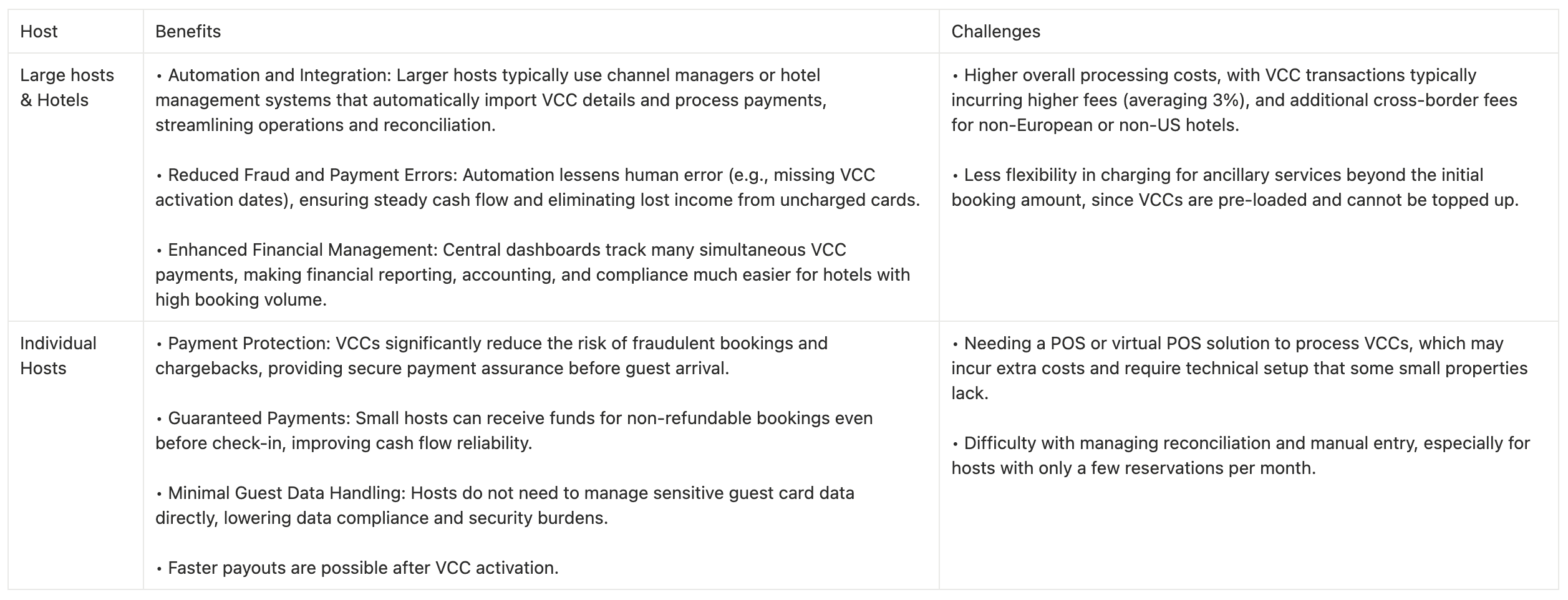
Both small and large hosts gain secure, fast payments with VCCs, but larger hosts benefit more due to automation and integrated systems.
How the VCC system works
Booking issues a VCC with each eligible booking, which the host processes using a POS or virtual terminal with the card details. Funds are deposited per the provider's schedule.
Key Points about the Booking.com VCC System
The VCC works as a digital Mastercard or Visa created for each booking. Its details are available in your Booking.com Extranet after the activation date, usually on check-in or the cancellation deadline.
Process the VCC using your POS or virtual POS just as you would for any card-not-present transaction.
Ensure your POS supports accommodation merchant and online transactions for VCC acceptance.
Funds are deposited based on your POS provider’s standard payout schedule, typically 2-3 business days.
Costs incurred with Virtual Credit Card (VCCs)
Booking.com Commission Fee
This is the standard fee that hosts pay per completed booking, typically ranging from 10% to 30% of the total booking value, with an average of around 15%, depending on location, property type, and the terms of the agreement.
Payment (POS) Processing Fees
To cash out a VCC, hosts must process the card through a POS or virtual terminal, incurring a credit card processing fee.
This fee typically ranges from 2% to 3% per transaction, similar to other card-not-present (online/virtual) credit card transactions. It is collected by the POS provider or acquirer (e.g., Pesapal, DPO, iPay for a Kenyan host).
Some providers may charge setup or integration fees for the POS system, but ongoing costs are typically limited to per-transaction fees.
Additional Costs and Notes
Booking.com does not explicitly charge additional fees for VCCs beyond the commission and standard processing fees incurred through the POS provider.
Hosts may also incur fees for optional add-ons, such as payment links, depending on the POS service used, but these are not VCC-specific.
Banks or payment processors may have additional minor fees based on currency conversion or local regulations.
Why is the VCC system facilitated through partnerships?
Booking delivers almost everything through partnerships, as its primary value proposition is the aggregation and facilitation of marketplaces, rather than the direct provisioning of travel services. This means:
It does not own or operate accommodations, payment processing infrastructure, or travel services; instead, it integrates or partners with providers that do.
This model reduces capital risk and operational complexity, as the platform focuses on marketing, customer acquisition, booking management, and trust-building tools, rather than logistics or infrastructure.
Payment processing in some regions (especially Africa) is fragmented or complex due to regulatory, technological, and banking infrastructure limitations, so Booking.com relies on local or third-party payment partners instead of building or managing payment systems directly.
Why is it challenging to automate payment collection on Booking?
Across Africa, most hosts report that Booking.com does not process payments on their behalf; reservations are confirmed, but payment must be made at the property or collected via non-integrated means, such as bank transfers or custom payment links. This limitation results in practical challenges, such as an increased risk of no-shows, fraud, and administrative hassles. Discussions with operators across Africa, including Kenya, highlight that the absence of integrated payments is a regional issue; most African countries face similar challenges, prompting hosts to opt for cash collections or costly external platforms.
Attempts by Kenyan hosts to use Booking.com's virtual credit card (VCC) system have met restrictions, such as the inability to access full card details for charging, suggesting the feature is either limited or requires further onboarding that may not be supported in Kenya. In summary, direct card payment facilitation by the platform for Kenyan hosts is unavailable for most property types; manual and third-party solutions remain the default options for collecting non-cash payments from guests.
Alternatives for hosts today
Obtain a POS or virtual POS to cash out VCCs and reduce cash handling.
Request manual prepayment via trusted, verified links, acknowledging trust barriers for guests.
What should change
Localised rails: First‑class support for mobile money and regional acquirers, not only card rails.
Accurate host payouts: Automated settlement to bank accounts or mobile wallets without POS hardware.
Better risk sharing: Product mechanisms that lower no‑show exposure when bookings are confirmed without upfront payment.
Until these gaps close, individual African hosts will continue to be underserved by systems optimised for hotels and mature payments ecosystems.
Are you a Booking host? How do you collect your digital payments? Have you discovered a solution that automates payment collections? Share in the comments, I’d love to know how you are solving this problem.
we are building a such platform for Kenya first,
another hostel I stayed in had similar problems